
- Salale University, Ethiopia
- president@slu.edu.et
- +251-111355637
Background
Contact
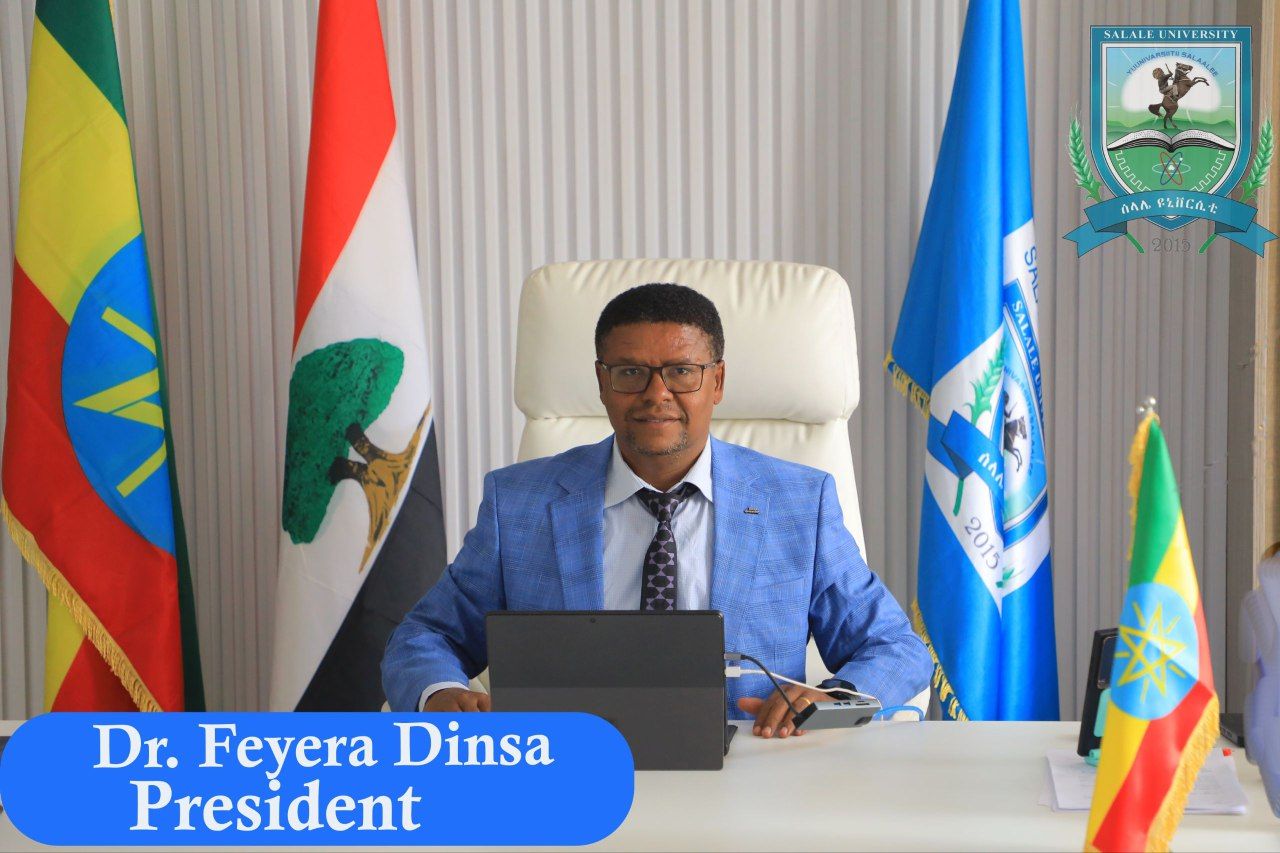
Name: Feyera Dinsa (Ph.D)
+251911235189
president@slu.edu.et
+251-111355637
P.O. Box: 245
Administration Building 3rd floor Room 3
Background of Salale University
Salale University was established in November 2015 under Proclamation No. 359/2015 and is recognized as a Comprehensive University among Ethiopia’s public higher education institutions. It is located in Fitche town, Oromia Regional State, approximately 112 kilometers from Addis Ababa, the capital city. The university’s core mandates are to provide quality education that prepares students for the international job market, conduct problem-solving research, transfer knowledge to the wider community, and offer need-based community and consultancy services. At its inception, Salale University began with 616 regular undergraduate students enrolled in nine academic programs under the College of Agriculture and Natural Resources, the College of Business and Economics, and the College of Health Sciences. At that time, academic activities were carried out by 106 teaching staff and 226 administrative staff. Since then, the university has grown significantly, now employing 1,752 staff members, including 779 academic staff, 173 medical professionals, 40 technical assistants, and 760 administrative personnel. The student population has also increased to more than 5,233.
The university held its first graduation ceremony in 2011 E.C., awarding degrees to 221 students from the College of Agriculture and Natural Resources and the College of Business and Economics. Salale University currently operates on three campuses: the General Tadesse Biru Campus, which houses the College of Agriculture and Natural Resources, the College of Business and Economics, the College of Natural Sciences, and the College of Social Sciences and Humanities; the Abebech Gobena Campus, which is dedicated to the College of Health Sciences; and the Ganda Farda Campus, which is under construction and designated for the Faculty of Engineering and Technology.
Salale University is governed by a Board, a President, and a Managing Council. The university’s operations are overseen by two Vice Presidents: one for Administration and Development, and the other for Academic, Research, Community Engagement, and Technology Transfer. Since 2016 E.C, the university has made continuous progress in expanding its teaching-learning, research, and community service activities. To support this ongoing development and meet the growing demand for efficient and high-quality services, the university is committed to strategic planning. By aligning its mission and vision with measurable goals using the Balanced Scorecard (BSC) approach, Salale University contributes to national efforts aimed at improving the socio-economic, environmental, and legal well-being of society through its core functions.
Fitche ,Ethiopia
Upcoming Events
Calendar
| Su | M | Tu | W | Th | F | Sa |
|---|